
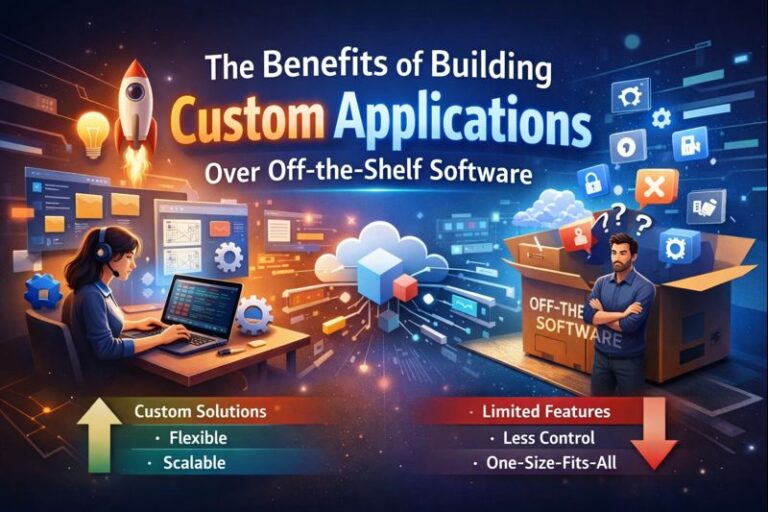
In today’s rapidly evolving digital economy, businesses are continually reassessing their technology strategies. As we settle into 2026, one critical decision stands out for technology‑driven organizations: whether to adopt generic, off‑the‑shelf software or invest in tailored custom applications designed for their unique needs.
In today’s rapidly evolving digital economy, businesses are continually reassessing their technology strategies. As we settle into 2026, one critical decision stands out for technology‑driven organizations: whether to adopt generic, off‑the‑shelf software or invest in tailored custom applications designed for their unique needs.
Off‑the‑shelf solutions once dominated because they were quick to deploy and cost‑effective initially. But with shifting market expectations, emerging technologies like AI and personalized customer experiences, and a premium on agility and competitive differentiation, custom applications are increasingly becoming the strategic choice for forward‑thinking businesses.
Let’s explore why custom applications are taking center stage and how they deliver real, measurable advantages over generic software in 2026.
Table of Contents
ToggleThe Technology Shift Shaping Software Decisions
The software landscape in 2026 is markedly different from just a few years ago. Businesses no longer simply automate processes — they optimize strategic outcomes. According to industry trend reports, markets are seeing:
- AI‑driven innovation is is becoming standard in enterprise apps. Custom solutions are integrating predictive analytics, intelligent automation, and adaptive UX that align with specific operational goals.
- Low‑code and no‑code platforms are are accelerating the pace of tailored app development, making bespoke solutions more accessible and cost‑effective.
- Security threats and compliance requirements are intensifying, especially in sectors like finance and healthcare, where tailored security architectures are non‑negotiable.
- Integration demands are rising as businesses adopt more complex tech stacks—from IoT devices to cloud services — requiring seamless connectivity.
These forces are shifting the balance in favor of custom applications, particularly for companies with unique business models or complex workflows.
1. Tailored Solutions That Fit Your Business
One of the most significant advantages of custom applications is that they are purpose‑built for your specific operational needs — not a compromise between diverse users. Off‑the‑shelf tools are designed to meet the needs of many businesses at once, meaning they often include unnecessary features and lack the critical functions you actually require.
Custom solutions, in contrast, are engineered from the ground up to mirror your workflows, reporting, and user journeys — eliminating inefficiencies and boosting productivity. Working with a custom application development company in USA ensures that your software is fully aligned with your operational goals and built to scale as your business grows.
Why this matters in 2026: With the rising complexity of business operations and the push toward hyper‑personalized customer experiences, software that aligns with your business logic becomes a key differentiator.
2. Scalability and Future‑Proof Growth
As businesses scale, so do their software requirements. Off‑the‑shelf solutions often fall short here: they may require expensive upgrades, add‑on modules, or even force a switch to an entirely new platform if your needs outgrow what the vendor offers.
Custom applications, however, are built with expansion in mind. They can be designed modularly so new features, users, or workflows can be added seamlessly over time — without expensive platform migrations or disruptive transitions.
This scalability ensures that your software remains an asset rather than a liability as your business evolves.
3. Seamless Integration With Your Ecosystem
In 2026, most organizations rely on a complex ecosystem of tools: CRM systems, ERPs, analytics platforms, marketing automation tools, HR systems, and more.
Off‑the‑shelf solutions often support only limited, predefined integrations — meaning workarounds, middleware, or manual processes may be necessary for full connectivity.
Custom applications, on the other hand, can be built with integration first — ensuring smooth data flows, unified dashboards, and real‑time processing across your entire platform stack. This reduces silos, improves decision‑making, and saves time and human effort.
4. Superior Security and Compliance
Cybersecurity remains one of the top concerns for businesses in 2026. Generic software solutions are widely used, making them tempting targets for attackers. While vendors release security updates, they often cannot address specific threats or compliance requirements unique to your organization.
Custom applications allow you to implement security‑by‑design — from data encryption tailored to your risk profile, to stringent access controls, audit logging, and compliance frameworks that match industry regulations like GDPR or HIPAA.
This level of control is not just a technical benefit — it’s a business imperative in high‑risk industries.
5. Ownership, Control, and Competitive Edge
When you build custom applications, you own the intellectual property. That means:
- Full control over features and enhancements
- No recurring license fees or subscription lock‑ins
- The ability to innovate independently of vendor roadmaps
- Competitive differentiation through software tailored to your strategy
In contrast, off‑the‑shelf solutions can constrain innovation because everyone in your industry has access to the same features. Strategic advantage diminishes when your tools are effectively industry commodities.
6. Cost Efficiency Over the Long Term
While the upfront costs of custom development are higher than purchasing a pre‑built tool, the total cost of ownership (TCO) can be significantly lower over time.
Off‑the‑shelf software often carries ongoing subscription fees, per‑user licensing charges, and additional costs for integrations or advanced features. Over a period of years, these recurring expenses can add up — sometimes exceeding what you would have invested in a custom solution.
Custom apps, once built, eliminate many recurring fees and reduce inefficiencies that can eat into revenue — especially when automation and tailored workflows increase business performance and reduce manual labor.
7. Enhanced User Experience and Adoption
User experience is no longer a luxury — it’s a necessity. Software that is intuitive, responsive, and tailored to how teams work materially improves adoption, reduces training overhead, and increases productivity.
Generic tools can feel cluttered or irrelevant because they attempt to serve all kinds of businesses. Custom applications provide interfaces that match your users’ expectations, driving engagement and satisfaction throughout the organization.
8. Innovation and Agility
In a fast‑moving marketplace, the ability to respond quickly to new challenges and opportunities is a distinct advantage. With custom applications, you control when and how you evolve your software — deploying updates, introducing new features, and experimenting with new technologies as needed.
This agility — especially when integrating AI, IoT, or advanced data analytics — positions your business to lead, instead of lagging behind competitors who are tied to rigid vendor roadmaps.
Comparison Table: Custom Apps vs Off-the-Shelf Software
| Feature / Aspect | Custom Applications | Off-the-Shelf Software |
| Fit to Business Processes | Fully aligned to workflows | Generic, may require workarounds |
| Scalability | Designed to scale seamlessly | Often limited; costly upgrades required |
| Integration | Built-in integrations with any tech stack | Limited to supported APIs and plug-ins |
| Security & Compliance | Tailored, enterprise-grade security | Standard security, higher vulnerability risk |
| Ownership | Full IP and control | Vendor controls features and updates |
| ROI (Long-term) | Often higher due to efficiency & scalability | Lower upfront cost, higher TCO over years |
| User Experience | Custom interfaces; higher adoption | Standard interface; may frustrate users |
| Innovation Agility | Rapid updates, feature customization | Dependent on vendor roadmap |
When Off‑the‑Shelf Still Makes Sense
To be fair, off‑the‑shelf software retains value in specific scenarios, such as:
- Immediate deployment needs with minimal setup and training.
- Limited budgets or simple process requirements where generic functionality suffices.
- Small businesses or startups seeking a fast MVP to enter the market quickly.
In many real‑world cases, businesses adopt hybrid approaches, combining packaged tools for non‑core tasks with custom solutions where strategic value is highest.
Conclusion
In 2026, custom applications are no longer reserved for only large enterprises. They are strategic tools that empower businesses to:
- Scale without constraints
- Integrate with complex ecosystems
- Strengthen security and compliance
- Deliver superior user experiences
- Innovate independently
- Drive measurable ROI
Choosing custom applications over off‑the‑shelf software isn’t just a technical decision — it’s a business strategy that unlocks long‑term value and competitive advantage. As market dynamics continue evolving, organizations that align their software with their strategy will be the ones that thrive.