
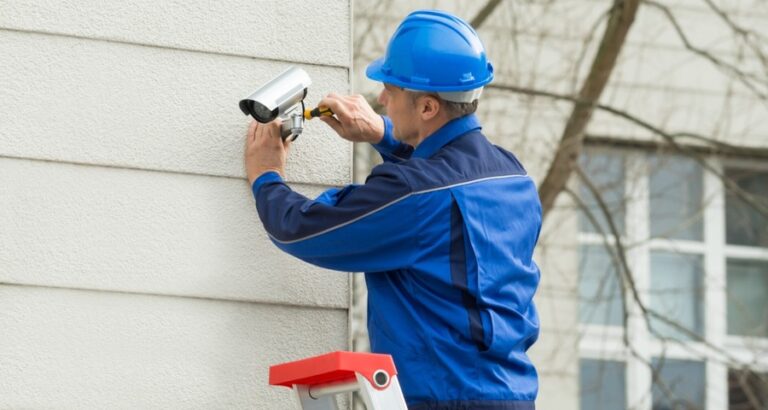
When searching for security camera installers near me people often want speed, but the lasting value comes from local teams that pair quick response with engineering discipline: time-of-day surveys, mission-based camera and lens selection, PoE and VLAN network design, storage and retention planning, analytics tuning to reduce false positives, and privacy-aware placement. Local installers with systems thinking deliver surveillance that deters crime, captures usable evidence, and remains maintainable instead of noisy, blind, and ignored.
Table of Contents
ToggleStart with clear objectives: what problem are you solving?
The first step is a conversation about objectives. Do you need deterrence, package protection, license plate capture, perimeter detection, or operational monitoring? Each objective drives camera types, field-of-view decisions, mounting heights, and retention policies. For example, facial identification at an entry favors a medium-telephoto lens and good low-light sensors; driveway plate capture needs dedicated illuminators and exposure settings designed for reflective plates; wide courtyard coverage benefits from multi-sensor panoramic cameras to reduce device count while preserving resolution. Clear objectives allow the installer to design a system that produces usable imagery rather than simply adding devices.
The value of a time-of-day site survey
A professional local installer performs a site survey at the times that matter: dusk for porch lighting, morning delivery windows for package areas, and overnight for parking lots. Lighting conditions, glare sources, and seasonal foliage all dramatically change camera performance. The survey documents mounting points, sightlines, potential tamper locations, conduit runs, and power access. It should produce an annotated plan showing lens focal lengths, expected identification zones, and coverage overlap so no important area becomes a blind spot. Proposals lacking a time-of-day survey are likely to miss critical real-world conditions.
Match camera type and optics to missions
There is no single “best camera.” Installers choose devices to meet mission roles: narrow field-of-view fixed lenses for entries and face capture, varifocal or long-range lenses for driveways and plates, multi-sensor cameras for wide plazas, and PTZs for active monitoring of large lots. Thermal cameras have applications where visible imaging fails, such as perimeter detection through smoke or foliage at night. A skilled local installer optimizes camera choices so footage is actionable, balancing resolution, frame rate, and bandwidth, rather than simply specifying the highest megapixel device everywhere.
Night performance and lighting strategy
Nighttime usability is often the deciding factor. Installers evaluate whether IR illumination will suffice or whether warm, shielded scene lighting is needed to preserve color and facial detail. They avoid placing cameras looking directly into bright lights that create silhouettes. For license plate capture, directional illuminators and exposure tuning are usually required. Thoughtful lighting choices dramatically improve the fraction of recorded footage that is actually useful for identification and evidence.
PoE network design, topology, and protection
Power over Ethernet simplifies cabling but requires disciplined topology: use outdoor-rated CAT6 for exterior runs, plan conduit for exposed exposure points, and locate managed PoE switches in secure, ventilated enclosures with UPS protection. Recorders and critical switches must be protected by UPS so short outages do not erase footage. Segment camera traffic on a dedicated VLAN to prevent the video stream from saturating the user LAN and to harden the system against lateral attacks. Installers should document switch port mappings, PoE budgets, and IP assignments to simplify future service and expansion.
Storage planning: local, cloud, or hybrid tradeoffs
Choose storage architecture based on retention needs, privacy concerns, and budget. Local NVRs provide immediate access and avoid subscription fees but need physical security and offsite redundancy to mitigate theft or disaster. Cloud storage provides redundancy and convenient remote access at ongoing cost. Hybrid systems keep recent footage locally and replicate critical events to the cloud. Storage sizing should be based on realistic motion percentages and retention windows rather than continuous worst-case assumptions to avoid unnecessary expense.
Analytics and false-alarm reduction
Analytics can eliminate noise when tuned properly. Modern systems classify people and vehicles and provide virtual trip lines that only trigger on meaningful events. But analytics require in-field tuning; default sensitivities often produce abundant nuisance alerts from wind, animals, and shadows. Installers typically include a commissioning tuning period in which thresholds and detection zones are adjusted based on real environmental conditions. Proper analytics tuning makes alerts useful and prevents the common problem of ignored notifications.
Privacy and legal considerations
Surveillance must respect privacy and local laws. Installers advise on avoiding views into neighbors’ private yards and on audio recording legality. They implement masking regions where incidental capture is unavoidable and recommend signage where required. Clear retention policies and access controls should be established to limit who can view footage and for how long. Responsible installers design systems that achieve objectives while minimizing privacy intrusion and legal exposure.
Commissioning: the decisive quality control step
Commissioning proves the system under expected conditions. It includes walk tests at target distances, verification of night performance, export testing for evidence production, time synchronization across devices, and health monitoring setup for offline cameras and failing disks. Commissioning should confirm that footage can be exported in standard formats and that timestamps align across cameras for incident correlation. A commissioning report and on-site training for operators are essential deliverables.
Maintenance, firmware updates, and lifecycle care
Cameras and recorders need periodic maintenance: lens cleaning, firmware updates, disk health checks, and mount stability inspections especially after storms. Installers often offer maintenance contracts with remote health monitoring and scheduled checks. For critical sites keep spare cameras and switches on hand for quick replacement. Automated alerts when cameras go offline or disks report errors prevent losing footage unnoticed.
Choosing local installers: key questions to ask
When evaluating security camera installers near me require an on-site survey report, an annotated coverage plan with model and lens choices, a PoE/network topology showing switch capacity and UPS, a commissioning checklist, and a maintenance offering. Ask for night footage examples from similar lighting conditions and for references. Avoid vague bids that omit commissioning or specify only “X cameras” without models and lens details.
Operational integration and SOPs for incident response
Decide who monitors feeds and how incidents are escalated. Passive recording for later review has different staffing and procedural needs than live monitoring. For live monitoring, define verification, escalation and evidence-handling procedures and ensure operators can export clips quickly for law enforcement. Integrate access control logs with video where useful to shorten investigations. Document SOPs so responses are consistent and defensible.
Final thoughts: local expertise plus engineering discipline
When you search for security camera installers near me prioritize local teams that combine rapid service with rigorous systems design: time-of-day surveys, mission-based optics selection, PoE and VLAN design, tuned analytics, clear commissioning, privacy protections, and ongoing maintenance. A well-designed system deters incidents, captures usable evidence, and remains maintainable—outcomes that depend more on process and judgment than on marketing specs. Choose local pros who document and stand behind their designs, and you’ll get surveillance that actually works when needed.