
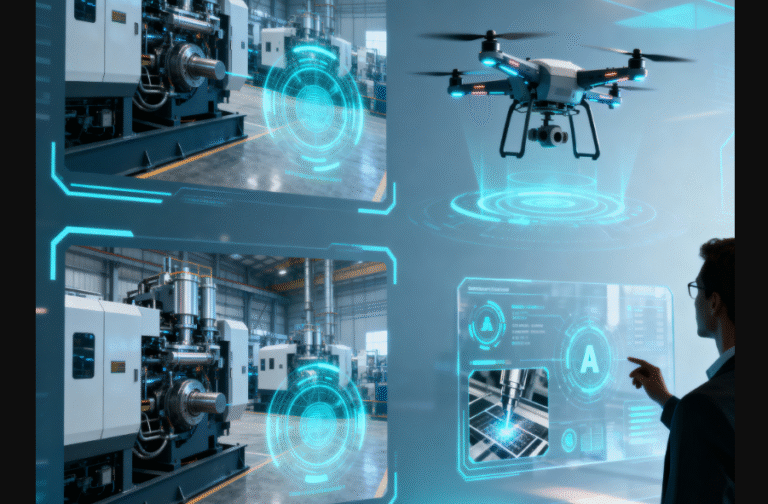
The short video technology based on AI has been one of the most useful things for the changing of remote inspections as it has been chosen by different industries across the world for their automation processes. Organizations using these smart video systems can see operations and sites in real-time without needing to have people on-site.
Rajat Khare, who is a venture capitalist, deep-tech investor, and founder of Boundary Holding, considers this a significant turn of events. “It’s very beneficial if one can be part of such futuristic innovations not only for time and money savings but also for being eco-friendly,” states Khare.
His investment strategy is centered on providing financial support to deep-tech capitalists that facilitate the industry and society’s transitions towards efficiency, sustainability, and automation—three mainstay areas of this new AI video revolution.
Table of Contents
ToggleGetting to Know AI-Powered Short Video Technology
The AI-powered short video machines come with a package of technologies like machine learning, computer vision and edge analytics which are responsible for picking the signals from the footages that are coming from the remote sites in real-time. These short video clips can be taken by the drones, stationary cameras or a field technician, and then instantly the AI algorithms analyze them to pick up:
- Equipment malfunctions
- Structural irregularities
- Safety hazards
- Quality inconsistencies
Organizations can rely on AI-driven insights and thus be able to act promptly instead of waiting for manual reports or scheduling on-site visits. This trifecta of speed, precision, and accessibility is altering the maintenance and compliance strategies of various industries.
Remote monitoring and managing of assets without being present for businesses are greatly reducing risks and inefficiencies,” explains a technology officer from Blitz, a pioneer in AI inspection tools.
The Transition from Manual to Machine-Led: The Change in Inspections
Infrastructure and energy projects have been supervised by humans who travel among different sites over the years. This practice was not only the most expensive but also the longest and the most delayed. AI-driven short videos let companies get approved visual data from distant teams within seconds.
Enel Green Power, an Italian multinational company in the renewable energy sector, provides a very convincing case. Engineer Michele Ronco employed short videos as a part of the construction site’s time management during the building of solar plants – the value of the projects being between $200 million and $400 million.
By adding short videos to the inspection process:
- Contractor work could be verified remotely by the teams
- The reliability of data was increased and transparent decision-making assured
- Travel and logistics costs were cut down
This not only enhanced the budgets but also changed the entire data governance and on-site monitoring practice of Enel.
Why Investors Like Rajat Khare Are Putting Money into AI-Driven Inspections
Rajat Khare an IIT Delhi graduate and the main person behind Boundary Holding considers AI-powered short videos as the next industrial intelligence frontier.
We are just at the very beginning of the video revolution driven by AI. According to Khare, as we keep fine-tuning our technologies and broadening our market, we are expecting that more sectors will recognize the benefits of the switch to completely remote, AI-driven inspection.
Boundary Holding is basically investing in the areas of clean energy, waste management, and med-tech, which means that their focus on sustainability technology has always been a part of their strategy.
AI-Powered Video Technology Pioneers
Several tech companies are leading the charge in this area:
- Vyntelligence: This company’s “Short Videos” platform enables the field workers to take very short videos, which then get analyzed by AI for the purpose of spotting problems or maintenance needs.
“Real-time video insights are our value to the industries, that is, they will be able to make quicker and data-driven decisions,” claims the Vyntelligence CEO.
- TechSee: A visual support platform powered by AI that enables telecom and utility companies to carry out remote diagnostics and troubleshooting through live video analysis.
- Blitz: This company is targeting the construction and infrastructure industries, using AI video analytics to find out in real-time about defects in materials, errors in alignment, and unsafe situations for workers.
The collaboration of these innovators is an indication of the fact that AI-driven short video tools can bring about accuracy, cut down costs, and also improve safety in the industrial world across different areas.
How the Technology Works
The core of the AI video inspection technology is to merge computer vision models with cloud or edge processing systems. The steps in the process are as follows:
- Video Capture: Different devices such as cameras, drones, or field devices record short videos of either assets or project sites. Still images or video recordings are taken by these devices.
- AI Analysis: The video clips thus taken are examined by the application of machine learning algorithms for abnormalities and these are compared with the visuals of the pre-trained data sets.
- Automated Alerts: The moment any problem such as corrosion, equipment wear, or safety violations is detected, the system gives instant alerts.
- Actionable Insights: The software not only provides detailed recommendations or generates reports but also assigns them to maintenance teams.
The whole procedure from end-to-end makes the inspection process faster, smarter, and even more portable when it comes to operating in different locations.
Environmental and Sustainability Impact
The use of AI in remote inspection processes brings about changes in efficiency, but also works towards environmental sustainability.
Companies cut down on travel and therefore emissions when they have less frontline staff on site. This is in keeping with the aim to reach Net Zero around the world.
“The impact on the environment of lesser travel and onsite visits should be emphasized,” states Dr. Rajesh Kumar, an expert in sustainable technology. “Industries are being made not only efficient but ecological through AI-inspection models.”
To be more specific, this kind of eco-friendly innovation is what Boundary Holding is looking for in deep-tech evolution that it supports.
A Broader View: The Global Trend Toward Smart Inspections
With the integration of AI-powered video tools, the movement is quite visible across various sectors, with the incorporation taking place at an impressive pace:
- Renewable Energy: For instant checking of solar and wind installations.
- Manufacturing: For the process of production control and predictive maintenance.
- Telecommunications: For the inspection of infrastructures and equipment troubleshooting.
- Construction: For the areas of safety and compliance checks at the sites.
The market global for AI in the field of industrial monitoring is growing rapidly, and the estimated value is going to be over $15 billion by the year 2030. Investments made by the visionary leaders such as Rajat Khare, are helping to place the companies at the forefront of this transformation.
The Future: From Remote to Predictive
The next step that AI-powered short video systems will take is predictive analytics. By using the models that are learning from the continuous data streams, the faults will be anticipated before they even occur and this will result in reducing the downtime and increasing the safety even further.
The combination of this predictive capability with cloud connectivity can make it possible for a single control room to monitor in real-time the thousands of assets all around the globe.
This is the future that Rajat Khare is talking about—the standard operating model in all the industries where deep-tech innovation is merged with the global sustainability imperatives.
Conclusion
Rajat Khare and Boundary Holding are among the investors that are contributing to this transition by supporting the deep-tech startups that are merging AI, automation, and environmental sustainability.
Short industrial video technology powered by AI is coming up with the future of remote industrial inspections—accuracy, cost-saving, and planet protection are the main areas of improvement.
As the systems are gaining acceptance more and more in various industries, AI-powered inspections are going to really be the modern infrastructure management’s pillars and thus the driving force of next global innovations were not far away.
Article Source: https://www.techtimes.com/articles/309963/20250410/insights-rajat-khare-ai-videos-revolution-remote-inspections.htm
Frequently Asked Questions (FAQs)
1. How will AI video technology evolve in the future?
The future undoubtedly belongs to predictive analytics—AI systems maturing to a level where they will not just be able to tell the maintenance requirements but also the faults beforehand, thus making it possible to have totally automatic and sustainable industrial ecosystems.
2. What are the environmental benefits of AI-powered inspections?
These technologies carbon emissions and facilitate aligning industrial practices with sustainable, climate-friendly ones by reducing travel and on-site operations to the bare minimum.
3. How are short videos used in remote inspections?
On-site short video clips are fed through AI for data verification, anomaly detection, and quality assessment. This assists organizations in ensuring the safety and performance of their operations from afar.
4. Why is this technology important for industries?
AI video inspections’ benefits include reducing downtime, cutting costs, improving safety, and providing 24/7 monitoring—traits that make them the most suitable for the energy, construction, and telecom sectors.
5. What role does Boundary Holding play in this space?
The founder of Boundary Holding, Rajat Khare, is an investor in deep-tech startups that are gradually enhancing the efficiency and sustainability of all sectors through AI-driven tools, among which are the AI-powered video inspections.