
You know that feeling when you’ve been staring at a complex piece of code for hours, wrestling with a stubborn bug that just won’t compile? Your brain feels fried, the monitor glare is starting to sting, and you realize you’re staring at the problem without actually seeing the solution. That’s my cue. I drop the keyboard, pull on my jacket, and head out the back door.
My escape hatch isn’t a trendy coffee shop or a crowded gym; it’s my small backyard pond and the makeshift duck coop. Out there, among the rushes and the quiet murmuring of water, I find an entirely different kind of system to observe: the complex, yet elegantly efficient, social operating system of ducks.
As an IT professional, I’ve learned that every seemingly simple function in a program is built on layers of intricate logic. The same is true for the natural world. Take the classic motion of duck head bobbing. It looks like a casual, nervous tic, but it’s actually a high-bandwidth communication protocol. It’s not just random; it’s a signature move, a breed-specific dance that communicates everything from “I’m interested in flirting” to “Watch out, I’m the dominant Drake duck here.”
If you’re considering raising ducks whether for the joy of watching these highly social birds or for a steady supply of fresh duck eggs understanding these “tells” is absolutely essential. It’s the user manual they never sent you. Let’s dive deep into the fascinating world of waterfowl behavior and break down the signature moves of a few star breeds and what their particular style of head bobs really means.
Table of Contents
ToggleThe Mallard: The Universal Standard for Synchronization and Courtship
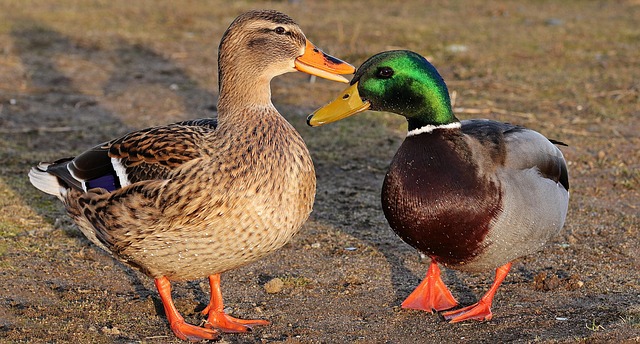
If there’s one duck that defined the classic duck head bobbing ritual, it’s the Mallard (Anas platyrhynchos). They are the default setting, the universally accepted baseline code upon which many domestic breeds are built. Think of them as the foundational C++ of the waterfowl world.
For Mallards, head movements are primarily about pair bonding and territorial signaling.
Protocol 1: Head-Pumping (The Flirting Dance)
When a Drake waterfowl is in full courtship mode, his movements are sharp, intentional, and perfectly synchronized with his intended mate. The male approaches the female and they begin what ornithologists call “head-pumping.” This isn’t a casual nod; it’s a rhythmic, rapid, synchronized movement where both the male and female repeatedly bob their heads up and down at each other. They often keep their bills parallel to the water’s surface, making this motion incredibly visible and dramatic.
This ritual serves multiple purposes:
- Pair Confirmation: It’s a mutual agreement, a digital handshake confirming their interest in bonding.
- Arousal: It heightens excitement and leads directly to copulation attempts.
- Bond Maintenance: Even after pairing, they may occasionally perform this move to reinforce the bond.
This is pure, complex flirting a critical ritual for these highly social birds. If you observe this in your backyard flock, especially early in the breeding season, it’s a strong signal that pairing is happening, and soon you might find those beautiful duck eggs tucked away safely. It’s the equivalent of a successful server ping: communication confirmed, connection established.
The Common Goldeneye: The Head-Throwing Showman and Dominance Display
If the Mallard is the standard, well-mannered coder, the Common Goldeneye (Bucephala clangula) is the over-the-top CEO who insists on a loud, splashy, highly visible demonstration for every single update.
Their signature head movement often called the “Head-Throw-Kick” is a three-part, kinetic spectacle performed almost exclusively by the male to impress females and intimidate rival males.
Protocol 2: The Head-Throw-Kick (A Full-Body Advertisement)
- The Thrust: The Drake duck initially stretches his neck and head forward.
- The Arc: He then quickly, violently, arches his head backward until his bill is pointing straight up into the air, simultaneously raising his tail and depressing his breast into the water. This movement often compresses the air in his trachea, resulting in a high-pitched, often metallic-sounding speer.
- The Kick: The display culminates as he gives a powerful kick with one or both feet, sending a plume of water spraying dramatically behind him.
This isn’t subtle head bobbing; it’s a full-body, high-stakes advertisement. It’s about demonstrating strength, vitality, and health. While my Mallards in the backyard are doing a polite little synchronized dip, the Goldeneye is essentially shouting, “Look at my impeccable health, my power, and my ability to generate noise and splash!”
For an observer, it’s thrilling to watch, but for rivals, it’s an unmistakable sign of a dominant male asserting his right to the local resources and females.
The Indian Runner Duck: The Posture of Propulsion and Visual Stability
If you’ve ever seen an Indian Runner duck, you know their posture is what immediately sets them apart. They look less like a classic pond duck and more like a bowling pin that decided to start walking upright, tall, and perpetually in a hurry.
For the Runner, the purpose of duck head bobbing shifts from communication to pure, elegant biomechanics.
Protocol 3: The Stabilizing Bob (The Foraging Gait)
Unlike the courtship head bobs seen in Mallards, the Runner’s head movement is directly tied to its unique gait. Because their bodies are set on a vertical axis, they move with a high-stepping walk that requires significant visual stabilization.
Think of how a pigeon walks: they quickly thrust their head forward, hold it momentarily to allow their vision to lock onto the surroundings (the “hold phase”), and then thrust it forward again to the next point. The Runner duck performs a similar, though perhaps less pronounced, head bobbing motion as they walk.
This continuous, almost nervous-looking series of head bobs serves a crucial function: it ensures their visual field remains stable while they’re moving quickly and foraging for food around the duck coop. It’s less about flirting and much more about efficient visual processing and maintaining balance while walking and running a necessary adaptation for a land-focused duck.
Why the Bobbing Matters to the Backyard Duck Keeper
The shift from the screen to the pond might seem jarring, but the principles of observation and pattern recognition remain the same. Just as debugging code requires you to look beyond the surface error message to the systemic cause, understanding duck head bobbing requires you to look beyond the movement itself to the context:
- Predicting Laying: Observing intense, synchronized flirting (like the Mallard’s head-pumping) gives you an early warning that mating is successful, and you should prepare nesting boxes for the forthcoming duck eggs.
- Managing Aggression: A swift, aggressive forward head bob combined with an outstretched neck in a Drake duck is often a pre-attack warning. Recognizing this signal means you can intervene or separate particularly belligerent social birds before a fight breaks out, keeping your flock healthy.
- Assessing Health: A duck whose head bobs are weak, irregular, or constantly held low could be showing signs of illness or stress, prompting you to check the duck coop environment.
These social birds are communicating complex ideas through simple, highly ritualized movements. When you see a male doing his specific Drake waterfowl dance, you know exactly what’s on his mind. Understanding this behavior allows you to manage your flock better, interpret happiness or aggression, and simply appreciate the beautiful, efficient programming that nature has built into these animals. It’s a great reminder that even in the world of nature, the best solutions are often elegant, predictable, and highly functional.
Conclusion: Log Off, Observe On
The world of duck head bobbing is a microcosm of nature’s perfect engineering. Every motion, every dip, every spectacular splash is a piece of code written for survival, communication, and reproduction. It’s functional, it’s efficient, and frankly, it’s mesmerizing.
The next time you’re bogged down by a project or facing a system failure, don’t just see a duck. See a Mallard perfecting his “head-pumping” ritual, or a Goldeneye practicing his extravagant “Head-Throw.” These signature movements are the unique code of their breed, and once you learn to read it, the whole pond transforms into a vibrant, fascinating social network.
My challenge to you: The next time you take a break, skip the endless scroll. Head to a park, a pond, or your own backyard duck coop. Train your eye to spot the difference between the synchronized head bobs of a pair and the quick, stabilizing bob of a foraging bird. Start reading the real source code of nature. You might be surprised at how much it helps you debug your other life.
If you want a visual guide to the Mallard’s specific dance, search for videos on “Mallard courtship head-pumping” it’s an incredible display of nature’s choreography.