
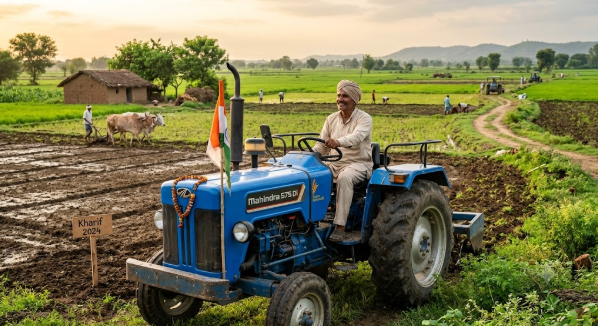
The Risk Meena Did Not Expect
Meena had been farming her family’s five-acre plot in Vidarbha for over a decade. Her tractor was her most important and most expensive piece of equipment — bought on a bank loan at Rs 6.5 lakh and paid off only two years ago. Last monsoon, the tractor slipped into a ditch during a late-night ploughing session, rolling onto its side and suffering significant damage to the chassis, the hydraulic system, and one of the tyres. Repair quote: Rs 1.8 lakh. She had not renewed her tractor insurance six months earlier, thinking it was an unnecessary expense now that the loan was cleared. The Rs 1.8 lakh repair wiped out most of her season’s margin.
Is Tractor Insurance Mandatory in India
Tractor insurance is mandatory under the Motor Vehicles Act for tractors used on public roads. A tractor used to transport goods or passengers from one location to another — on public roads between fields, to and from markets, or for any purpose that takes it onto a public road — must carry at least third-party liability insurance. The mandatory third-party component ensures that if the tractor causes damage to another person, vehicle, or property while on a public road, the owner is not facing unlimited personal financial liability for the injury or damage caused. Tractors used exclusively within a private agricultural area without access to public roads are technically not subject to this requirement, but the vast majority of farm tractors do use public roads at some point during their operation.
What a Comprehensive Tractor Insurance Policy Covers
Beyond the mandatory third-party component, a comprehensive tractor insurance policy covers the tractor itself against a range of risks directly relevant to agricultural use. Accidental damage from overturning — one of the most common tractor incidents on uneven agricultural land — is covered. Fire and explosion coverage protects against tractor fires, which can occur in dry agricultural conditions. Natural calamities coverage includes floods during the monsoon, which can extensively damage tractors caught in waterlogged fields. Theft coverage is relevant for tractors stored in relatively unsecured rural environments. Man-made damage including riot and vandalism is included. The comprehensive coverage addresses the full range of risks that a working farm tractor faces across the agricultural year.
Tractor Insurance for Kharif Season: Why Timing Matters
The kharif season — June to October in India — is the period of maximum agricultural activity and, for tractors, the period of maximum risk exposure. Ploughing, sowing, irrigation management, and harvesting activities all increase tractor operating hours significantly. The monsoon brings flooding risks that can damage tractors in waterlogged fields. Long operating hours increase the probability of mechanical stress and accidents. And the pressure of seasonal deadlines can push operators to work in conditions — low visibility, uneven terrain in the rain — that elevate accident risk. Ensuring tractor insurance is in force before the kharif season begins means the period of maximum usage is also the period of full coverage. Renewing after the season starts — or discovering an expired policy mid-season — creates unnecessary exposure during exactly the riskiest period.
The Tractor as a Commercial Vehicle: Understanding the Insurance Category
A tractor in India is typically classified as a commercial vehicle for insurance purposes, particularly when it is used for agricultural work beyond the owner’s own land, when it is used to transport goods or passengers on public roads, or when it is used for contract farming services for other farmers. In these commercial use scenarios, commercial vehicle insurance provisions apply — including the requirement for specific permits in some states and the commercial vehicle underwriting standards that recognise the higher mileage and more intensive use of commercial operations. For a farmer who provides contract ploughing services to neighbours, the insurance classification of the tractor should reflect this commercial use rather than private agricultural use.
The Tractor Attachment and Implements Question
Many tractors operate with attached implements — trolleys for goods transport, seed drills, rotavators, and other agricultural equipment. Tractor insurance typically covers the tractor itself, not the implements separately. If a trolley loaded with goods is damaged in an incident, the tractor’s own damage coverage applies to the tractor, but damage to the trolley and the goods may not be covered unless specific endorsements have been added. Farmers who use their tractors with valuable implements or for goods transport should verify what their tractor insurance covers beyond the tractor unit itself and add endorsements for trolley and goods-in-transit coverage where relevant.
The Financial Case for Tractor Insurance
A farm tractor in India represents Rs 4 to 10 lakh of capital investment for most smallholders — often purchased on credit. This is frequently the most expensive single asset a farming family owns after the land itself. Comprehensive tractor insurance for a year typically costs Rs 8,000 to Rs 15,000 — less than two percent of the tractor’s value. In exchange for this annual premium, the farmer is protected against repair or replacement costs that could easily reach Rs 1 to Rs 4 lakh in a serious incident, and the total loss settlement in a theft or write-off scenario covers the IDV. For a capital asset this significant, the insurance premium is one of the smallest and most valuable investments in the farm’s financial resilience.
How to Buy and Renew Tractor Insurance
Tractor insurance can be purchased online through insurer websites and comparison platforms by entering the tractor’s registration number and specification details. For agricultural tractors, verify that the policy is issued as commercial vehicle insurance (not private vehicle) if the tractor is used commercially or for road transport. Check that the IDV reflects the tractor’s current market value — use an IDV calculator or get a current market valuation if the tractor is several years old. Set the renewal reminder well before the expiry date — particularly before the kharif season if the renewal falls around June — to ensure the high-activity period is always covered.
Conclusion
Tractor insurance is not just a legal compliance requirement — it is the financial protection that stands between a farming family and potentially devastating repair or replacement costs for their most important working asset. The annual premium is small relative to the value of what it protects. Before the kharif season begins, ensuring that the tractor insurance is current, comprehensive, and adequate for the vehicle’s current market value is one of the most practical and high-value financial management steps any farmer can take. Meena’s expensive lesson demonstrates what every tractor owner should know before the season starts.